
Task Lifecycle & Moderation
The Mindrift API operates asynchronously for image generation workloads and other tasks. Because deep learning synthesis requires several seconds of dedicated GPU compute, generation requests return immediately with a unique task ID, allowing your client application to track execution without holding long, fragile HTTP connections open.
This document describes the state machine governing each task, the lifecycle statuses and how automated content moderation is enforced.
The Asynchronous Flow
Submission
Your application submits a generation request with your prompt, model, resolution and parameters. The API authenticates your credentials, validates parameters against the model specification, checks your account balance and reserves a concurrency slot.
Immediate Acknowledgment
The API responds immediately with an HTTP 200 OK containing a task descriptor with status queued:
Status Polling
Your application queries the task endpoint at regular intervals (recommended every 1.5 to 2.5 seconds) until a terminal state (completed or failed) is reached.
Task Statuses
Each generation task progresses through a defined state machine:
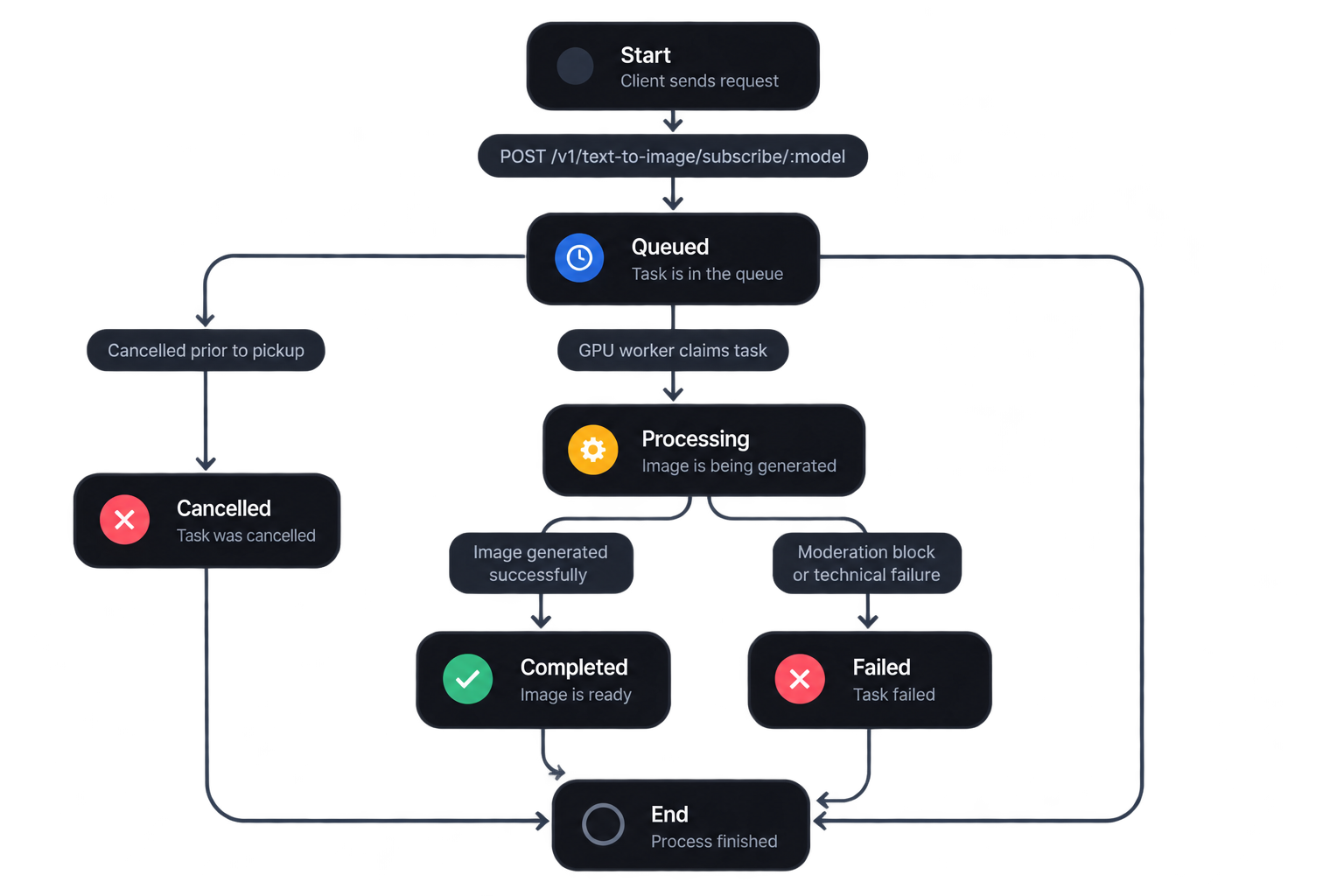
Active vs. Terminal States
- Active States (
queued,processing): Count toward your account’s concurrency limit (maxConcurrentTasksdefined by your API Tier). - Terminal States (
completed,failed,cancelled): Concurrency slots are immediately released upon transition to any terminal state, allowing subsequent requests to proceed.
Detailed Status Descriptions
queued
The initial state returned immediately after request submission. The job is registered in the database and assigned a position in the dispatch queue. Under normal traffic conditions, tasks typically spend under 1 second in this state.
processing
A GPU worker has dequeued the task. The diffusion pipeline is actively running the requested number of inference steps at the target aspect ratio and resolution.
completed
The task has finished successfully. The response object includes:
output.images: Array of objects containing direct CDN URLs to the rendered images.cost: The exact amount deducted from your wallet balance in USD.completed_at: ISO 8601 timestamp marking completion.expires_at: ISO 8601 timestamp when the hosted files expire (null= kept indefinitely, see Image Retention).purged/purged_at: whether and when the hosted files were deleted (manually or by expiry). A purged task returnsoutput.images: []— the task itself stays queryable.
Completed Task Example
failed
The task could not be fulfilled. The response includes an error object containing:
code: Machine-readable error code.message: Human-readable explanation.retriable: Boolean indicating whether resubmitting the task is likely to succeed.
Content Moderation & Safety
To comply with global regulatory standards and infrastructure provider policies, Mindrift enforces strict automated content moderation.
Moderation Criteria
Prompts and generated media are evaluated against automated safety classifiers. Content falling into any of the following categories is strictly blocked:
- Child Sexual Abuse Material (CSAM) or exploitation of minors (zero tolerance, logged for legal reporting).
- Explicit Not-Safe-For-Work (NSFW): Non-consensual sexual content, explicit pornography, or nudity on non-permissive models.
- Extreme Violence & Gore: Depictions of real-world torture, self-harm, suicide, or graphic physical trauma.
- Hate Speech & Harassment: Generating dehumanizing imagery targeting protected classes, hate symbols, or non-consensual deepfakes.
How Moderation Manifests
When a prompt or generated image triggers our safety classifier, the task transitions to the failed state with the CONTENT_MODERATION_BLOCKED error code:
Key Moderation Rules
- No Charge (
cost: null):
Your wallet balance is never charged for tasks blocked by content moderation. Any credits reserved during submission are automatically refunded. - Non-Retriable (
retriable: false):
Automated retries will not bypass moderation filters. Your client application should detectretriable: falseand present feedback to the user rather than re-queueing the identical prompt.
Technical Failures vs. Moderation
When inspecting a failed task, always evaluate the error.retriable flag:
Retrying Failed Tasks
For errors where retriable is true, you can trigger an immediate re-execution using the retry endpoint without needing to reconstruct the full payload:
The retry endpoint verifies your balance and active concurrency quota, resets the task to queued and dispatches it to a fresh worker node.
Best Practices for Integration
- Poll With Backoff: Start polling 1.5 seconds after task creation. If the task remains
processingafter 5 seconds, increase the polling interval to 2.5 seconds to conserve your tier’s polling RPM. - Set a Client-Side Timeout: While GPU workers enforce internal execution timeouts (typically 60–120 seconds), your application should establish a client-side timeout threshold (e.g. 90 seconds) to handle edge-case network partitions.
- Persist Generated Assets: Image URLs returned in
output.imagesare served via high-speed CDN. We recommend transferring production assets to your own object storage (S3, Cloudflare R2, Google Cloud Storage) if you require indefinite archival. - Expire When Appropriate: Pass
ttl(seconds,3600–2592000) at creation to auto-delete hosted files after a delay, or callDELETE /v1/images/{id}anytime. See Image Retention.